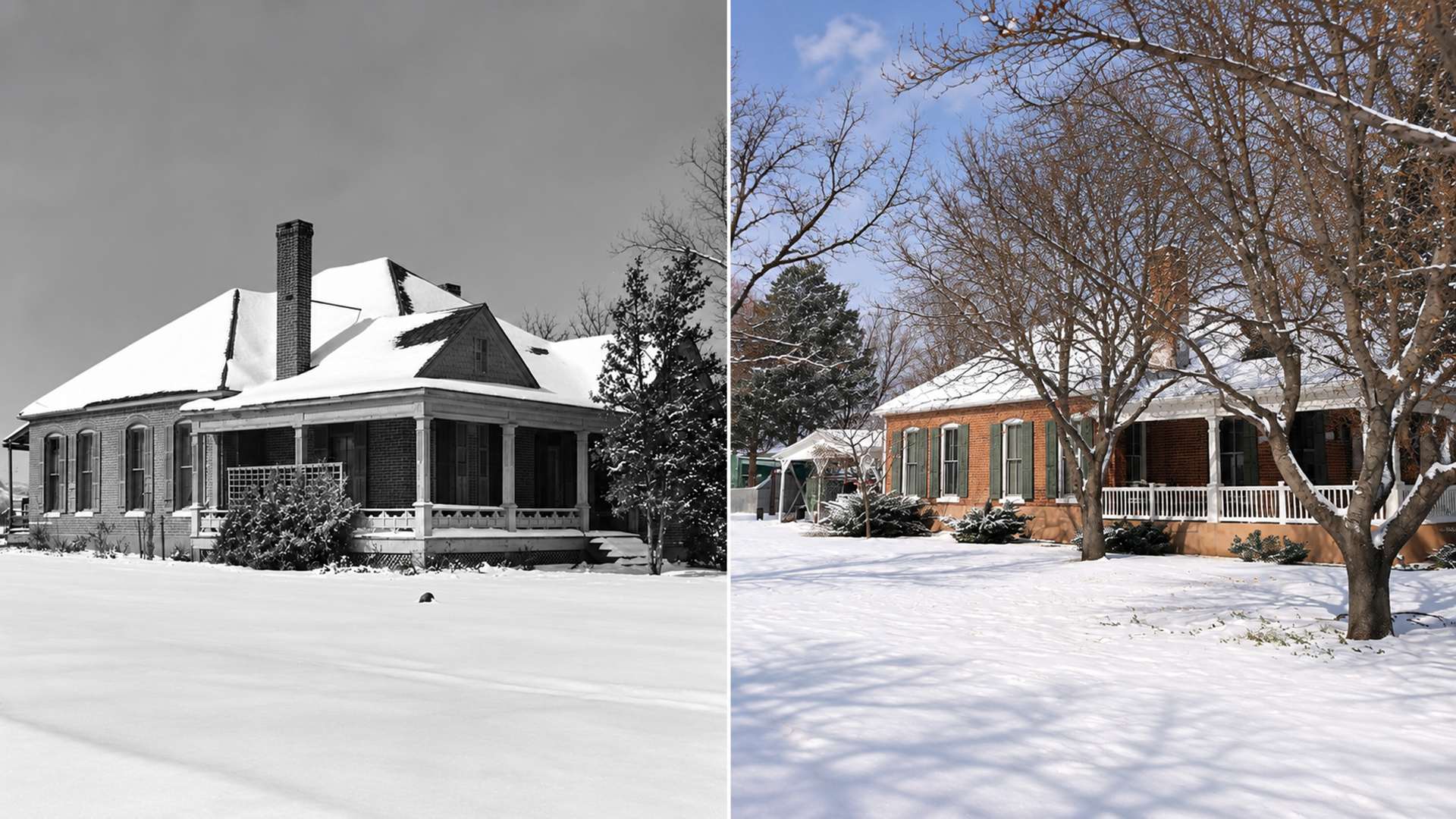
When W. D. Kincaid built this house in 1887, Alpine wasn’t even Alpine yet.
The settlement along the Southern Pacific Railroad was still called Murphyville, and it had already had another name before that. In just a few years, the little community went from Osborne to Murphyville and, finally, to Alpine. By the time that last name became official in 1888, the red-brick Victorian house at what is now 403 North 8th Street was already here.
Almost 140 years later, much of that original house remains. The tall windows, hardwood floors, transoms, beadboard, elaborate interior spindlework and five fireplaces are still part of the house today.
But some of the most interesting things about an old house aren’t architectural details. They’re the stories of the people who lived inside it. And this house has accumulated quite a few.
From Osborne to Murphyville to Alpine
Alpine began with the railroad. When the Southern Pacific arrived in 1882, the railroad section station was named Osborne, and the small settlement that developed around it took the same name.In 1883, the railroad needed a reliable supply of water for its steam locomotives and entered into an agreement with Thomas O. Murphy. In exchange for changing the name from Osborne to Murphyville, the railroad received the right to build and maintain a pumping station at the Burgess Water Hole, the historic spring on the northeastern edge of town later known as Kokernot Spring, and use its water.¹
By the summer of 1887, residents were circulating a petition asking the U.S. Post Office Department to change the town’s name to Alpine. That was the same year W. D. Kincaid was building his house.¹
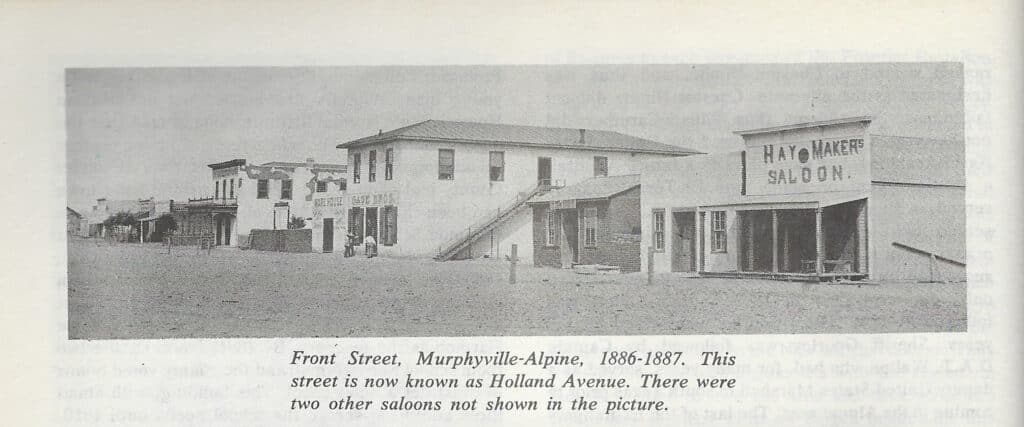
Front Street, Murphyville-Alpine, 1886–1887, now Holland Avenue. From Clifford B. Casey, Alpine, Texas: Then and Now, p. 26.
Exactly how Alpine got its new name isn’t certain. Clifford B. Casey recorded two versions in Alpine, Texas: Then and Now. In one, C. E. Way, who would become Brewster County’s first county and district clerk, was taking a young woman for a buggy ride. She had traveled in Europe and seen the Alps, and thought the mountains surrounding the little West Texas settlement made Alpine an appropriate name. The other version has Way and a group of men, including Walter Garnett, waiting for the mail and discussing possible names. Garnett opened a postal guide, came across Alpine, Alabama, and discovered there was no Alpine listed in Texas. The name was suggested, and it stuck.¹
Whichever version is true, the change soon became official. In January 1888, local residents voted 60 to 11 to incorporate the town under the name Alpine. The U.S. Post Office Department officially approved the name change on February 3, 1888.¹
Alpine was still tiny. A longtime resident interviewed in 1932 remembered that in 1888 the town had no more than twelve houses, three saloons, one hotel and a rooming house. The largest building in town was the livery stable.¹ W. D. Kincaid was already part of this young community. Contemporary records place him in the area’s ranching community by at least 1885, and he later operated Kincaid & Altgelt, a general mercantile business specializing in building materials. Historic Alpine identifies his house as having been built on land originally owned by the Murphys.²
For such a small West Texas town, Kincaid built a surprisingly substantial home: a red-brick Queen Anne Victorian.
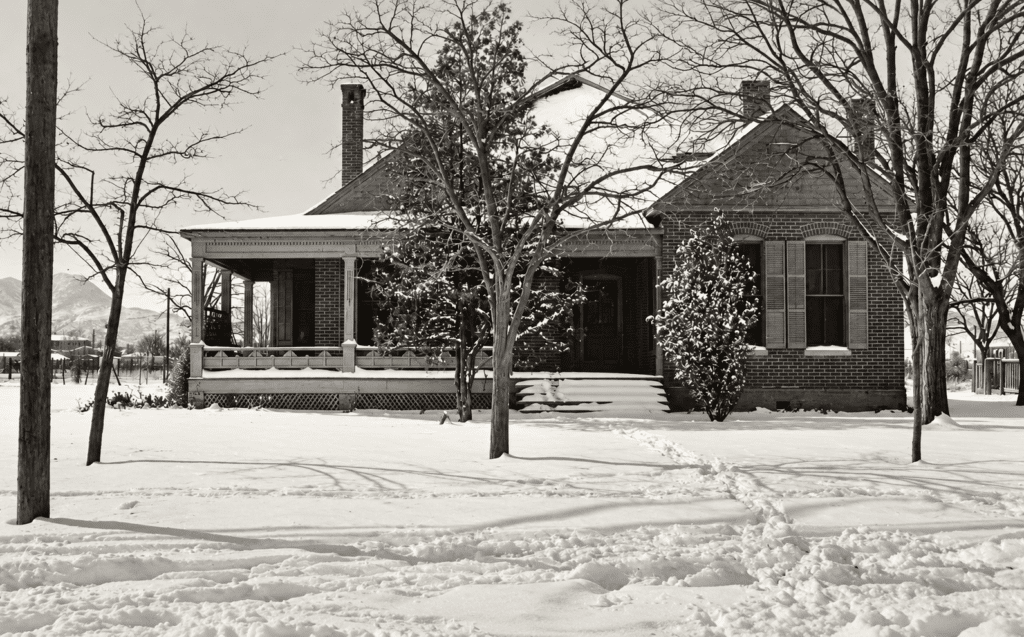
A Victorian House in West Texas
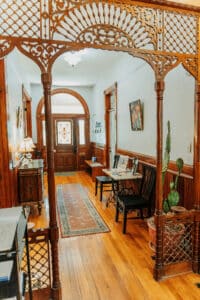
Original interior spindlework frames the central hallway of the Kincaid-Wade House.
High ceilings and seven-foot windows helped move air through the rooms. Transoms above the doors could be opened to improve circulation, and doorways connected the main rooms. Elaborate wooden spindlework divided spaces without completely closing them off.
Five coal-burning fireplaces provided heat during Alpine’s cold winters. The fireplaces remain today, along with their mantels and much of their decorative tilework.²
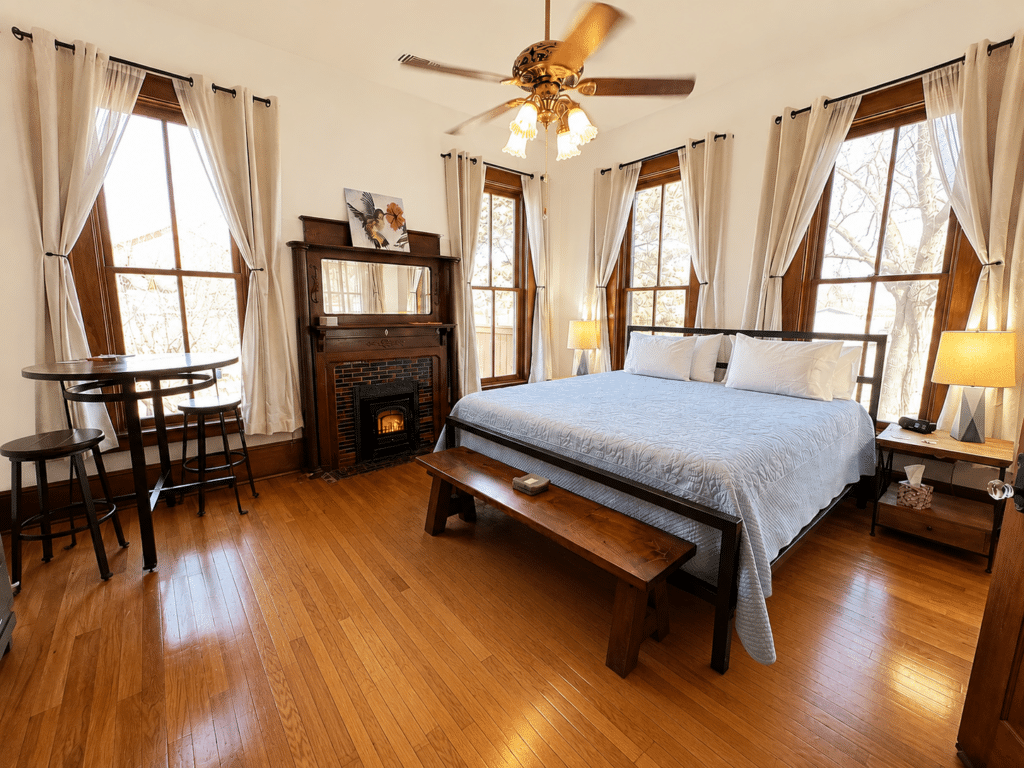
And then there was the formal parlor. Today, that room is our Chisos Guestroom. Its five tall windows, hardwood floor and original fireplace remain, but one of the most interesting pieces of its Victorian past is something much simpler.
The wide doorway between the formal parlor (now the Chisos Guestroom) and sitting room has two doors. When the house was used for courting, one door could be kept closed while a curtain hung from a wooden dowel across the other half of the doorway. The curtain gave a courting couple a little privacy while parents in the adjoining room remained close enough to serve as chaperones.
Decorative spindlework originally spanned the top of that doorway, above the dowel and curtain. We moved it to its current location between the sitting and dining rooms so that everyone can enjoy it. It’s one of two intricate pieces; the other separates the front from the back central hallway.
When we bought the house, the wooden dowel was still in place. We eventually removed it when we remodeled the parlor and created the Chisos Guestroom, but we’ve kept it safe until we find a place to display it again.
The Wade Family Arrives
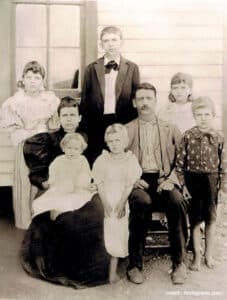
James Lewis Wade and Mary Elizabeth “Molly” Barnes Wade with their children. Photo contributed by jt, findagrave.com.
In 1905, James Lewis Wade purchased the house and moved his family to Alpine.³
Wade was a Kentucky native who had come to Texas as a young man and spent years in the livestock business. When he moved to Brewster County, he also acquired a cattle ranch in the Glass Mountains north of Marathon.
Wade raised cattle and horses, including horses sold to the United States Cavalry. Before the arrival of the Orient Railroad made livestock shipment easier, Wade and his sons participated in long cattle drives to rail connections and markets in places including Fort Worth, Oklahoma, Dodge City and Kansas City.³
But the Wade family’s influence in early Alpine went well beyond ranching.
James’s wife, Mary Elizabeth Barnes Wade, was a businesswoman in her own right. She established what Clifford B. Casey described as the first mechanically operated laundry in the area, a fully equipped steam laundry. Experienced operators were brought to Alpine while local workers were trained.³
During the World War I influenza epidemic, hospital facilities at Fort D. A. Russell were expanded to care for the sick. Mrs. Wade’s laundry provided service to the fort and hospital, and she received a special merit award from the United States government recognizing that work.³
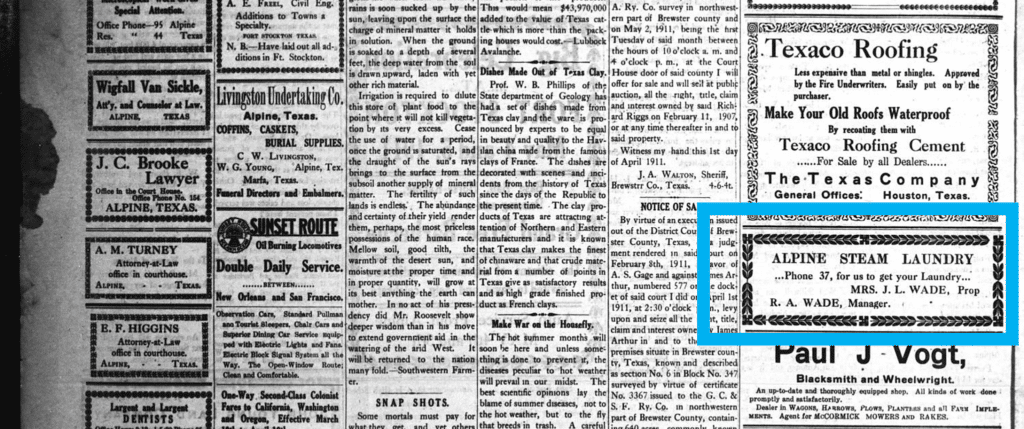
Alpine Steam Laundry advertisement, The Alpine Avalanche, Vol. 21, No. 18, April 27, 1911, p. 6. Courtesy of The Portal to Texas History, University of North Texas Libraries.
More Than a Family Home
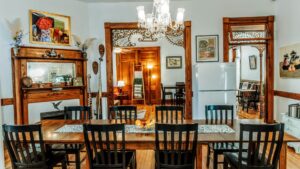
The dining room still serves its original purpose. Decorative spindlework above the opening leads into the sitting room, while a second, more elaborate piece frames the central hallway.
The Wades had eight children, so the house was already busy. But family life was only part of what happened inside it.
Musical programs, recitals, educational lectures and other community events were held here. Various religious denominations used the house for services while their own church buildings were being constructed.³ The Alpine Church of Christ was organized in the Wade home and held Sunday and midweek services here for several years.³
It’s difficult to look at these rooms today without imagining how different they must have sounded then. The same spaces that now hold breakfast conversations and guests planning a day in Big Bend once held a family of ten, music, lectures and entire church congregations.
The Wades were also active in Alpine’s Masonic Lodge, Eastern Star and other civic organizations, and were involved in supporting Alpine’s public schools and the establishment and growth of what was then Sul Ross State College.³
The Wades were part of a growing Alpine, and much of that community life found its way into their home.
Miss Electa
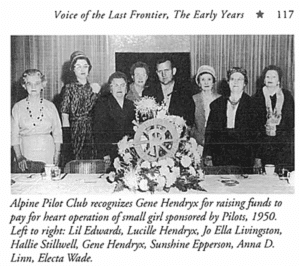
Alpine Pilot Club, 1950. Electa Wade is pictured at far right. From El Paso Hendryx, Voice of the Last Frontier: The Early Years (1996), p. 117.
Of the eight Wade children, Electa Wade would have the longest connection to the house. Electa never married and remained closely associated with the family home for decades. But her story was hardly confined to the house.
Her name appears throughout Alpine’s civic life. She worked professionally, led local organizations and charitable campaigns, and devoted considerable time to community causes. By the 1960s she was serving as president of the Alpine Cemetery Association and chairing Brewster County’s Easter Seal campaign.⁵
Over the years, Electa rented part of the house to boarders. And unlike much of its earlier history, that chapter isn’t confined to archives and old newspapers. Some of the people who knew Miss Electa and lived here are still part of Alpine.
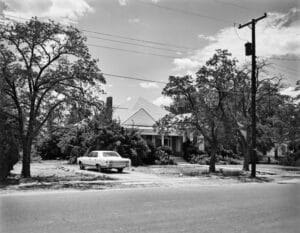
The Kincaid-Wade House, 1978. Texas Historical Commission historic resources survey. Courtesy of The Portal to Texas History, University of North Texas Libraries.
Miss Toni, who still lives just down the block, rented the south side of the house from Electa and lived here with her son for several years. Others who lived here have found us through social media or simply stopped by. One former resident remembers renting the south side with her husband in the 1960s after attending Sul Ross and marrying her sweetheart. Another remembers babysitting for a family that lived here after Miss Electa.
Electa eventually entered a nursing home in the late 1980s, but the house continued to be part of the community. College students were among those who rented it. During Viva Big Bend in 2026, two women stopped by and told us they had lived in the house during their years at Sul Ross University in the late 1980s and early 1990s and had wonderful memories, but they remembered a house divided very differently from the one guests see today. What is now our Eagle Peak Ensuite contained the kitchen and bathroom, and Twin Sisters, our fourth guestroom, didn’t exist yet.
The house may have changed over the years, but people continued to live here, love it and make memories within its walls.
The Years Between
We know much less about some of the families who lived here after the Wade years. We don’t even know all of their names, but they cared for this unique house, and a few of them left their marks.
In a concrete slab near the carport, two boys named Lee and Aaron pressed their hands into the wet concrete and dated them 10/2/87. Years later, on 5/6/10, a small dog named Cricket walked across another stretch of wet concrete, leaving a trail of paw prints behind.
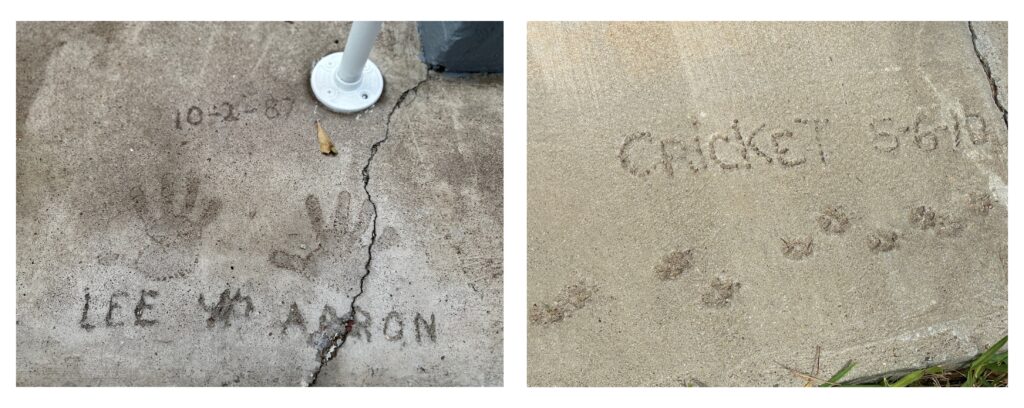
Not every chapter of a house’s history ends up in an archive. Some of it is memorialized in concrete.
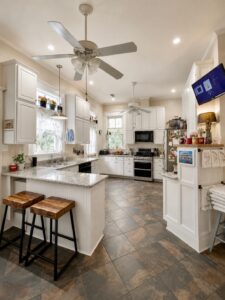 By around 2007, the house had another chapter. Jim and Cherry Jones purchased it and owned it for approximately twelve years before we bought it in October 2019. The Joneses roughly doubled the size of a kitchen that had been added sometime after Miss Electa passed away, and they added a bathroom at the back of it.
The House Changes Again
No house that has been lived in for nearly 140 years survives completely unchanged. Rooms have changed purposes. Bathrooms have been added. Kitchens have moved and expanded.

The Castle Rock Ensuite Bathroom. In addition to the large walk-in shower, it has an antique clawfoot tub that was relocated from the original home’s bathroom.
The clawfoot tub is a good example. People who knew the house before we owned it remember the tub, and it was here when we arrived. It was in what had once been the house’s only bathroom, the room that is now the Eagle Peak Ensuite bathroom.
We later moved the tub to the Castle Rock Ensuite bathroom when a former bedroom was converted to create the Castle Rock Ensuite and the private bathroom for Chisos.
Twin Sisters was added off the kitchen, probably sometime between 1995 and 2005. When we remodeled it and took the walls down to the studs, we discovered the 2x4s actually measured 2 inches by 4 inches, something some of the younger crew had never seen.
Twin Sisters already had a small bathroom when the Joneses owned the house. We updated it and installed a larger shower, updated the bathroom that became Eagle Peak’s ensuite, and created two additional bathrooms so that each of our four guestrooms could have its own private bathroom.
Chisos is the only guestroom whose bathroom isn’t ensuite. As the original formal parlor, adding a bathroom directly to the room would have meant sacrificing too much of the historic space.
The five fireplaces remain. So do the hardwood floors, the tall windows, original glass transoms, beadboard, and spindlework.
That’s part of owning a house this old. You don’t receive its entire history neatly organized in a folder at closing. Sometimes you find it in a newspaper. Sometimes it’s in an old photograph. Sometimes it’s a wooden dowel whose purpose you don’t readily understand. Sometimes two women walk through your front door during a music festival and tell you where their kitchen used to be. And sometimes it’s a neighbor who lived here with her son decades ago and stops by with a bumper crop of pecans to use in your recipes.
Still a House Full of People
When we bought the Kincaid-Wade House in 2019, we knew we were buying an old house. We didn’t yet know how many people would eventually help us understand it.
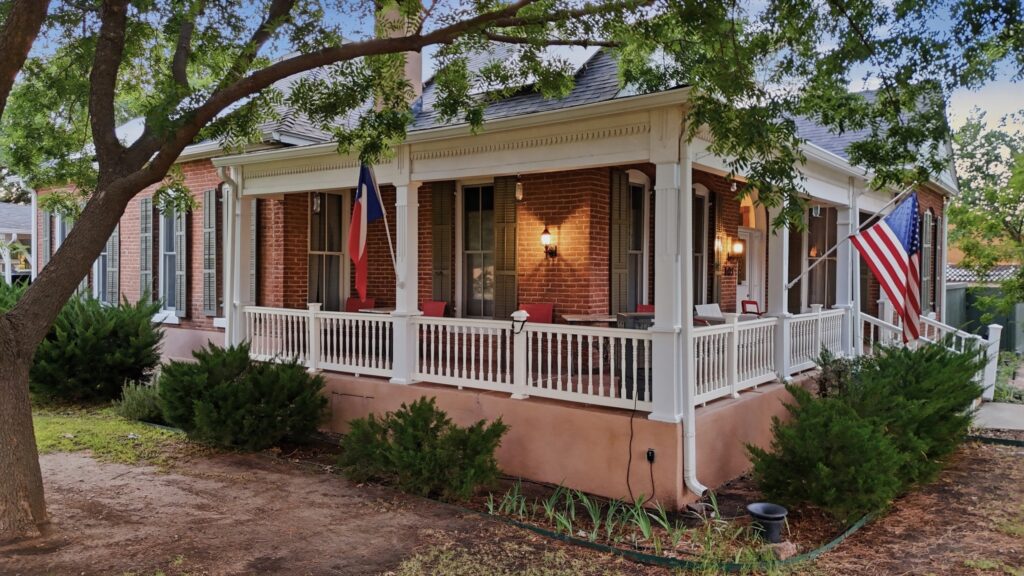
The Kincaid-Wade House today, now home to Alpine Bed and Breakfast. Almost 140 years after it was built, the house is still doing what it has done for generations: welcoming people who come through its doors.
Some of its history survives in archives and newspapers. Some survives in photographs. Some is built directly into the walls. And some survives only because people remember.
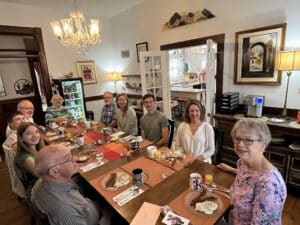
Generations of families have gathered in this house to mark important occasions, and it’s no different today. This 3-generation family gathered around the breakfast table to celebrate a college graduation.
Today, the house has another life as Alpine Bed and Breakfast. The formal parlor is our Chisos Guestroom. Where there was once a kitchen is now our Eagle Peak Guestroom, and where there was once a back porch is now a kitchen that turns out guest breakfasts every morning. The rooms that hosted church services, lectures and musical evenings are once again filled with people from all over.
We continue to find connections between the house’s past and the people who stay here today. Just this week, repeat guests Mark and Teresa came for their 5th stay and told us how they originally found Alpine Bed and Breakfast. They had been reading Clifford B. Casey’s Alpine, Texas: Then and Now, the same book we’ve used in researching this history, and came across the Kincaid-Wade House. They looked up the address on Google Maps and discovered that the house was now a bed and breakfast. That led to their first stay with us in 2021.
Alpine has changed enormously since the days when this was Murphyville. The house has changed, too, and we’re still discovering just how much of its story remains.
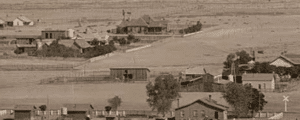
The Kincaid-Wade House in 1904, just 17 years after it was built. Enlarged detail from the panorama below.
One piece of the Kincaid-Wade House story has been hanging in our hallway all along. We have a 46-inch-wide, 2-panel photograph of a 1904 panorama of Alpine, taken from A Mountain. Guests often stop to study it, and one of our favorite things is being able to point out the Kincaid-Wade House and show them exactly where they are standing today.
In May 2026, the Alpine Downtown Historic District was listed in the National Register of Historic Places. The registration form includes this same 1904 panorama. We’ve joined those sections here so you can see Alpine as it looked more than 120 years ago, with the Kincaid-Wade House already part of it, as it appears in the 46-inch-wide photograph hanging in our hallway at Alpine Bed and Breakfast.
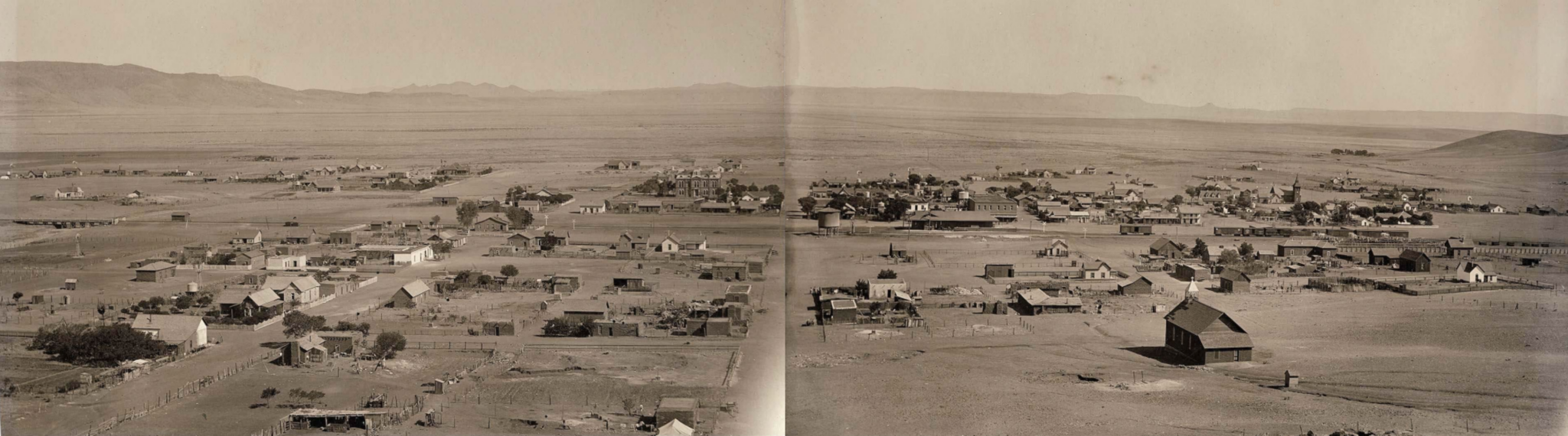
Alpine in 1904, viewed from A Mountain. The two sections included in the National Register of Historic Places registration form have been joined here to show the complete panorama. Source: Archives of the Big Bend, Sul Ross State University.
Do You Have a Story About This House?
One of the best parts of learning the history of this house has been hearing from people who were part of it. If you lived here, visited here, knew someone who did, or simply have a story, memory or photograph connected to the Kincaid-Wade House, we’d truly love to hear from you.
Please leave a comment below or email us using our contact information. Every story helps us understand a little more about the people who have called this house home, and we may add what we learn to this history so those stories aren’t lost.
Contact Us
For more information or to inquire about availability, please contact us at:
Phone: (432) 538-7032
Email: innkeeper@alpinetxbnb.com
Website: www.alpinetxbnb.com
Sharon & Tom
Alpine Bed and Breakfast
References and Further Reading
- Clifford B. Casey, Alpine, Texas: Then and Now, pp. 20–22. Principal source for the early Osborne/Murphyville/Alpine narrative, including the Murphy water agreement, the 1887 effort to change the name, the two accounts of how “Alpine” was selected, the January 1888 vote, the February 3, 1888 Post Office approval, and Mrs. Walter Garnett’s recollection of the size of the town in 1888. The Texas State Historical Association’s Handbook of Texas entry for Kokernot Spring identifies Burgess Waterhole as an earlier name for what later became known as Kokernot Spring.
- Historic Alpine, “The W. D. Kincaid/James Lewis Wade Home.” Source for the early history of the house, its association with Kincaid and Wade, the Murphy land, and historic features including the five originally coal-burning fireplaces.
- Clifford B. Casey, Alpine, Texas: Then and Now, pp. 379–380. Principal source for James Lewis Wade and Mary Elizabeth Barnes Wade, the Glass Mountains ranch, Wade’s cattle and horse operations, Mrs. Wade’s steam laundry and government recognition during the World War I influenza epidemic, gatherings in the Wade home, church services held there, organization of the Alpine Church of Christ in the house, and the Wade family’s civic and educational involvement.
- Alpine Avalanche, contemporary Alpine Steam Laundry advertisements, Portal to Texas History. Advertisements from 1910, 1911 and 1913 identify the Alpine Steam Laundry and list “Mrs. J. L. Wade, Prop.”
- Alpine Avalanche, contemporary reports concerning Electa Wade, Portal to Texas History; El Paso Hendryx, Voice of the Last Frontier: The Early Years (1996). Newspaper reports document Electa’s later civic activities, including the Alpine Cemetery Association and Brewster County Easter Seal campaign. The 1950 Alpine Pilot Club photograph showing Electa Wade at far right appears in Hendryx’s history of KVLF radio.
- National Park Service, National Register of Historic Places Registration Form: Alpine Downtown Historic District, Brewster County, Texas, National Register reference no. 100012985, listed May 11, 2026. The 1904 panorama of Alpine reproduced at the end of this article appears on pp. 73–74 and is credited to the Archives of the Big Bend, Sul Ross State University.
The later history concerning former residents, the Joneses, changes to the house, Lee and Aaron’s handprints, Cricket’s paw prints, the wooden dowel and the work we’ve done since purchasing the property in 2019 comes from the physical evidence at the house, our own experience, and conversations with people who lived here or knew the house.